
St. Louis County Criminal Court Cases
The 21st Judicial Circuit is St. Louis County’s state trial court. Circuit judges hear felony prosecutions, while associate circuit judges handle misdemeanors and other assigned matters. The Circuit Clerk at the Courts Building in Clayton maintains the filed case, docket, public documents, judgment, and sentence. The Prosecuting Attorney, located across the central Clayton justice campus, evaluates police referrals and files state charges. These roles are related, but their files are not interchangeable.
Municipal courts hear city ordinance and traffic matters within their own jurisdictions. St. Louis County Municipal Court also handles county ordinance and traffic cases. A municipal citation does not become a Circuit Court felony file merely because both may be indexed in Missouri Case.net. Start with the issuing agency, the case number, or the court named on a notice. That small check prevents a fruitless request at the wrong clerk’s counter.
Which St. Louis County Court?
The charge level and source point to the right St. Louis County court record. State felonies belong in the 21st Judicial Circuit. State misdemeanors generally appear in an associate circuit division. City ordinance and local traffic cases begin with the relevant municipal court, while county ordinance matters go to St. Louis County Municipal Court. An appeal may later create a Circuit Court entry, but the earlier municipal file remains a separate record.
The official county municipal court information identifies its local channel. Incorporated cities maintain their own court contacts, and many participate in Case.net. If a citation is absent online, call the clerk named on the ticket. St. Louis County surrounds the independent City of St. Louis, so a city court result from the City of St. Louis is not a county case.
Note: Court location, case type, and filing date are safer identity checks than a common name standing alone.
Searching St. Louis County Case Records
Missouri Case.net is the free public starting point for a St. Louis County criminal case search. It offers litigant, case-number, filing-date, scheduled-hearing, and judgment-index routes. An exact case number is the strongest key. A name search can work, but similar names require the reader to verify the court, filing date, case type, and other public details before treating a result as the intended case.
- Open Case.net and choose the case search path that matches what you know.
- Select St. Louis County, 21st Judicial Circuit, when the court is known.
- Enter the exact case number, or search the legal surname and first name. Narrow by case type or filing dates.
- Open each likely result. Compare the header, charges, docket, hearings, judgment, and financial entries.
- Ask the Circuit Clerk for public file review, copies, or certification when the needed document is not available remotely.
| Field Label | Type | Required | Notes |
|---|---|---|---|
| Court/Agency | Dropdown | Yes for scoped search | Select St. Louis County, 21st Judicial Circuit, or all participating courts |
| Last/Business Name | Text | Yes for litigant route | Use the legal surname; common names can yield many cases |
| First and Middle Name | Text | No | Useful narrowing fields |
| Case Number | Text | Yes for number route | Enter the exact court case number |
| Case Type or Filing Date | Select/date | Route-dependent | Narrow by criminal group, year, or date range |
St. Louis County File Viewer Access
A public docket does not mean every document can be opened from home. Missouri’s File Viewer help explains that courthouse public users logged in by court staff may see public documents that are not offered to an anonymous remote user. For St. Louis County criminal court records, that makes the clerk’s terminal a useful second stop when Case.net lists a filing but provides no downloadable image.
Confidential content stays restricted in both settings. Filing-information sheets, psychiatric evaluations, presentence investigations, probation or parole reports, and protected personal data do not become public because the main docket is open. When a public item is not available online, note its exact docket date and title before contacting the clerk. The clerk can identify access and copy options but cannot offer legal advice.
The St. Louis County Courts website shows the local court context. Its official home is captured below, and the image helps distinguish the county court source from statewide Case.net.
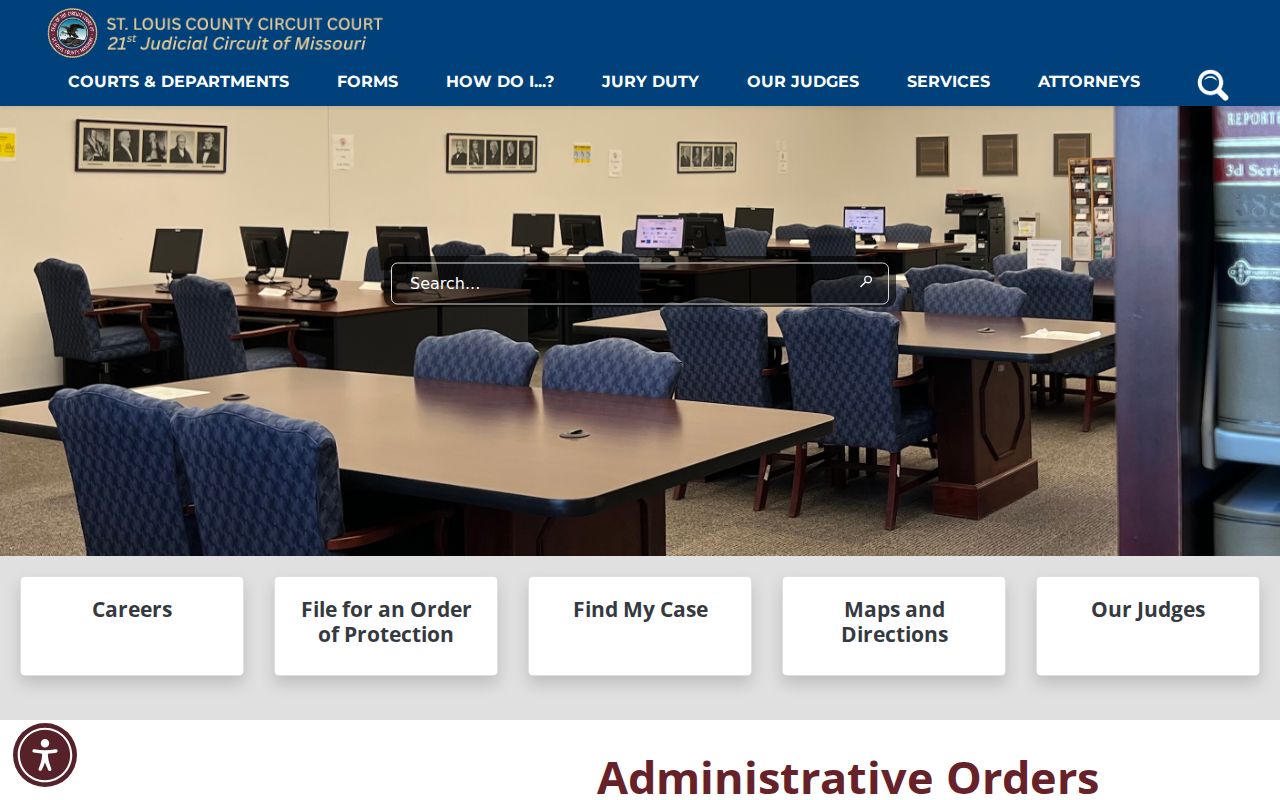
Use the county court source for clerk and division details, then use Case.net for the public docket search.
Inside a St. Louis County Case File
A St. Louis County criminal case file records what happened after a charge reached court. Its header identifies the case, venue, judge, division, filing date, type, and status. Charge rows must be read one by one because a single case can contain several counts with different outcomes. Docket entries then show the sequence of filings and hearings. The judgment and sentence provide the clearest answer about the final result.
| Case Number & Court | Unique case key, court or venue, filing date, division, judge, and status |
|---|---|
| Charging Document | Complaint, information, or indictment and each filed or amended charge |
| Docket Entries | Dated clerk record of warrants, counsel, bond, motions, pleas, settings, and orders |
| Hearing Dates | Event type, date, time, location or division, and judge |
| Disposition & Judgment | Outcome for each charge, such as conviction, dismissal, acquittal, or nolle prosequi |
| Sentence & Conditions | Custody, probation, costs, fines, restitution, and later compliance or violation entries |
Accessible documents and the financial ledger can add detail, but they do not replace the judgment. Full Social Security numbers, the day and month of birth, confidential addresses, and protected victim or minor information are redacted. A docket may also list an action before the linked filing is ready for remote view.
Read St. Louis County Dispositions
The presence of a St. Louis County court case does not establish a conviction. Read the disposition beside each count. “Dismissal” means the charge ended without a conviction. “Nolle prosequi” records the prosecutor’s choice not to continue that charge. An acquittal is a not-guilty result after trial. A conviction is a judgment of guilt. Mixed outcomes are common enough that the case title alone is a poor summary.
- SIS
- A suspended imposition of sentence with probation; Missouri treats access differently while supervision is active and after successful completion.
- SES
- A suspended execution of sentence means a sentence was imposed but its execution was suspended during probation.
- Docket entry
- The clerk’s dated record of a filing, hearing, order, or other court action.
- Disposition
- The outcome of a specific charge or the case.
Where wording remains unclear, compare the charge row with the judgment and sentencing entry. A plea agreement is a proposed negotiated resolution until court action appears. Later probation or compliance entries may affect status without changing the original charge outcome.
Note: Always read every count because one St. Louis County case can end with both dismissed and resolved charges.
How a Criminal Case Moves
The court file begins when the prosecutor files a complaint or information, or a grand jury returns an indictment. That filed charge can differ from the label used at arrest. The court records the initial appearance, bond activity, counsel, arraignment, pleas, motions, settings, and continuances. A plea or trial produces a disposition, followed by judgment and sentencing when guilt is found. Later probation or violation entries can extend the docket.
Case flow: Charges Filed › Arraignment › Pretrial › Plea or Trial › Disposition › Sentencing
Case.net may offer tracking notices, but the docket remains the source to check. Timing varies by the facts, motion practice, court schedule, and whether a trial is required, so no fixed local duration should be assumed.
St. Louis County Filed Charges
A police arrest label and a prosecutor-filed charge answer different questions. The arresting officer records the suspected offense at the time of custody. The St. Louis County Prosecuting Attorney reviews the referral and may file, amend, decline, or later dismiss charges. Once filed, the court assigns the case number and the clerk begins the judicial docket. That is why a booking sheet and a Case.net charge line may use different descriptions.
The Prosecuting Attorney’s office at 100 South Central Avenue handles state charges, but the Circuit Clerk is the custodian for the court file. A request for the public complaint, information, judgment, or docket belongs with the clerk. A request for prosecutorial records should identify the St. Louis County case and go through the office or county records custodian. Active work product and protected victim material may be closed.
St. Louis County Clerk Copies
A screen view is useful for research, but some needs call for a clerk-issued copy. The 21st Circuit fee schedule effective November 1, 2024 lists an authenticated copy at $3.50 plus $0.30 for each additional page. A certified one-page copy and seal is $1.50, with $0.30 for each added page. Certified mail adds $6. Verify the current total with the clerk before ordering because the document length and service method affect cost.
When making a request, supply the exact St. Louis County case number, document title, and docket date. State whether a plain, certified, or authenticated copy is required. The official 21st Circuit fee schedule also lists a $105.50 filing deposit for a qualifying Missouri conviction-expungement or arrest-expungement petition. That deposit is not a copy fee and should not be confused with the price of retrieving a docket document.
Case Record Access & Restrictions
Missouri Court Operating Rule 2 governs public access to judicial records and confidential information. Open St. Louis County court records can generally be inspected, but juvenile files, sealed or expunged matters, protected victim details, confidential addresses, psychiatric material, presentence reports, and probation or parole reports may be closed or redacted. Anonymous remote access can also be narrower than public terminal access at the courthouse.
If a St. Louis County case does not appear, confirm the spelling, venue, filing date, and whether the matter began in a municipal court. Very recent filings may not yet be visible. Older records may require clerk assistance. A closed result cannot be restored to public view merely through a records request. For the arrest and booking trail that preceded a filed case, use the separate St. Louis County arrest lookup channels.